
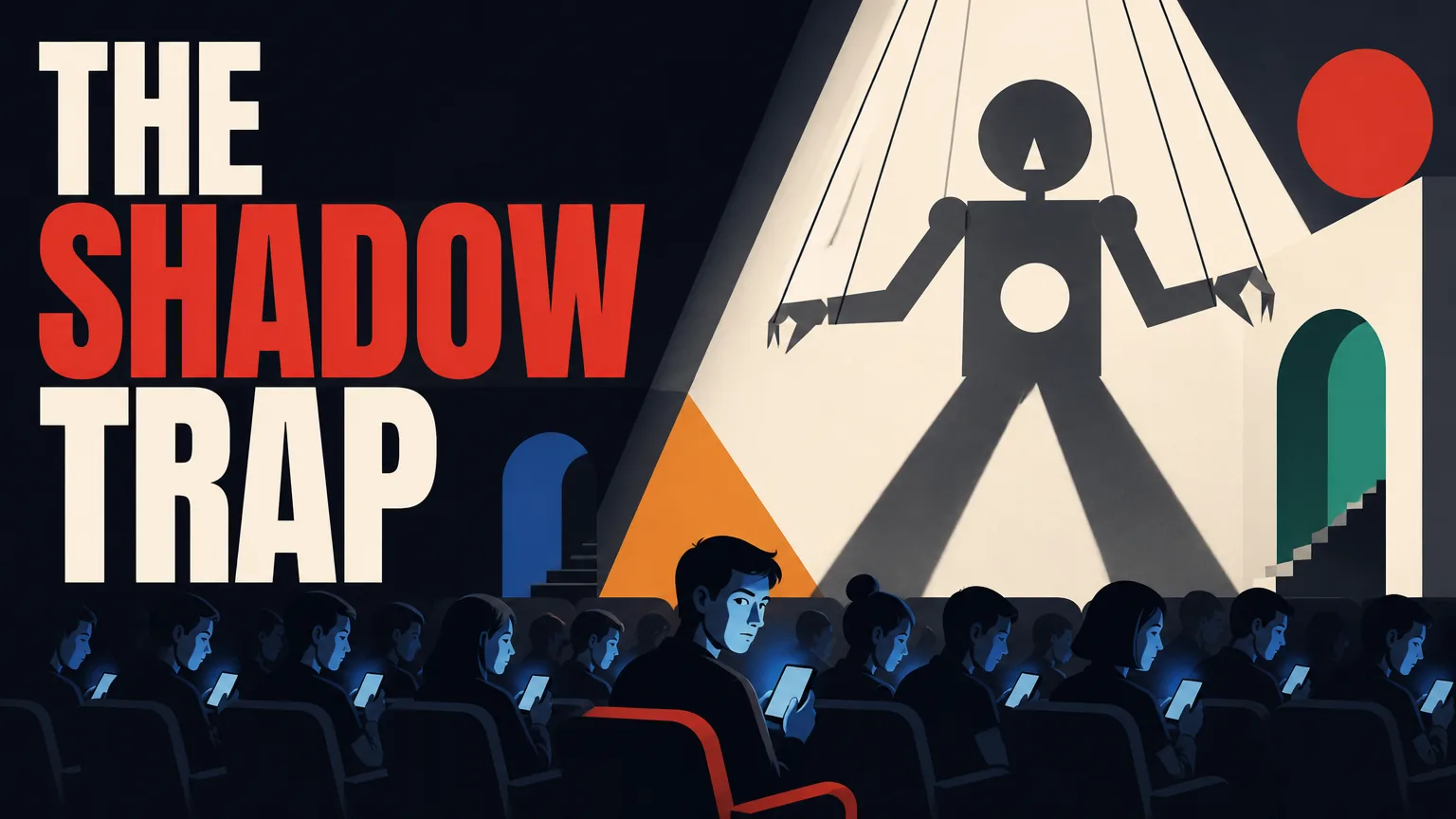
The New Plato's Cave: How Generative Shadows Replaced Reality
The deepest form of captivity is not being forced to believe a lie. It is losing the habit of asking what, beyond the image, would make belief answerable to reality.
At two in the morning, a bedroom becomes a theater for one. A cold rectangle lights the face; a thumb moves with the fluency of a practiced instrument. The screen offers outrage, beauty, catastrophe, intimacy—each item distinct, each available on demand. The room around the spectator recedes. The feed does not need to command attention. It only has to keep offering the next reason not to withdraw it.
More than two millennia ago, Plato described prisoners who mistake shadows for the world. The comparison is familiar enough to risk becoming another shadow: a clever analogy, consumed and forgotten. But the cave matters not because screens are literally walls, or because every image is false. It matters because Plato asks a harder question: What would it take to recognize that the world one knows has been arranged—and why might the first response to freedom be anger?
The cave is not a metaphor for ignorance alone
In Book VII of The Republic, Plato imagines people chained underground from childhood, facing a wall. Behind them burns a fire; between fire and prisoners, figures are carried along a raised path. The prisoners see only the shapes cast before them. Having never encountered the objects, the fire, or the people moving them, they treat the shadows as reality.
The allegory is often reduced to a lesson about misinformation: the shadows are fake, the outside world is true. But Plato’s scene is more unsettling. The prisoners are not fools who could simply correct an error by checking a source. Their whole vocabulary of reality has been formed by what they can see. The shadows are not merely what they happen to believe; they are the limits within which belief has become possible.
That is why the ascent is painful. When one prisoner is released and turned toward the fire, even the objects that produced the shadows initially hurt his eyes. The familiar wall seems clearer than the unfamiliar truth. Education, in Plato’s account, is not the insertion of facts into an empty mind. It is a reorientation of the person: a gradual learning to look toward what was previously unbearable or invisible.
The analogy to a modern screen is not exact, and should not be. We are not usually chained in one place, nor does a single set of puppeteers determine everything we see. Yet the essential arrangement persists: attention is directed, appearances are selected, and what recurs begins to feel natural. A feed is not simply a window onto events. It is a designed sequence in which some things become salient, some disappear, and the spectator can mistake the sequence itself for the world.
The important question, then, is not whether an image is real or fake in isolation. It is what conditions have made this image visible, repeatable, and difficult to ignore. A photograph may be genuine and still be framed to mislead. A true story may be placed beside a false one until the distinction becomes emotionally irrelevant. The cave is sustained not only by lies, but by arrangements that shape what can be noticed and compared.
The puppeteers need not conspire
Plato’s cave includes a parapet and people carrying crafted objects: a machinery behind the spectacle. In contemporary life, it is tempting to map these figures onto executives, platform owners, or political propagandists. Sometimes that mapping is warranted. Decisions about ranking, recommendation, moderation, and advertising are made by institutions with interests and power. The architecture of attention is not neutral simply because it is technical.
But a theory of hidden masters can become its own comforting shadow. It suggests that somewhere, a person fully understands the system and intentionally directs every image toward a single end. In reality, influence is often distributed across product design, commercial incentives, user behavior, and automated ranking. No one needs to coordinate a grand deception for the resulting environment to distort judgment. A system optimized to hold attention can amplify what provokes, flatters, frightens, or keeps a person scrolling—without anyone specifying, in advance, the precise beliefs each user will form.
Broadcast media offered a common wall: millions saw the same program, selected by a relatively small number of editors and executives. Social platforms personalize the parade. Neighbors can sit together and inhabit different informational worlds, each shaped by the histories and reactions attributed to that individual. Choice seems abundant because the user can select a channel, follow an account, or swipe away. Yet the machine still governs much of what arrives. The visible freedom to choose among offerings can conceal the prior power to arrange the menu.
This is one reason the language of “addiction” can be useful but incomplete. It locates the problem in a user’s compulsion, while leaving the environment that trains and profits from repeated attention largely untouched. A person may scroll without even liking, sharing, or commenting. Engagement need not take the form of an explicit choice. Remaining there is enough. The thumb supplies motion; the system supplies a succession of uncertain rewards.
The casino is a stronger analogy than the library, not because every post is gambling, but because the experience is organized around anticipation. Something more rewarding, more shocking, more affirming might appear next. The mechanism does not need to persuade the spectator of a single doctrine. It needs to make stopping feel like surrendering a possibility.
The return to the cave is a political problem
Plato’s released prisoner eventually reaches the outside and sees the sun, the source of life and visibility. But he returns to the cave. There he struggles to distinguish the shadows, and the other prisoners mock his impaired sight. When he tries to free them, they do not necessarily hear an invitation. They hear an attack on the only reality they know.
This return is often read as a story of the enlightened individual bringing truth to an ignorant crowd. That interpretation is too easy. The returning prisoner has changed, but he has not acquired a simple instrument for compelling recognition. His memory of the sun is not proof to those who cannot see it. Worse, his inability to navigate the familiar spectacle can make him appear less credible, not more. Insight does not automatically translate into persuasive authority.
The problem is therefore not merely that people resist correction. It is that perception is socially organized. What counts as a reliable image, a plausible account, or a respected witness depends on shared habits and institutions. When those habits fracture, disagreement over facts can become a struggle over who is entitled to describe reality at all. The heretic is then dangerous not because every claim they make is true, but because their refusal to accept the common wall exposes the wall as constructed.
A humane response cannot be to drag everyone toward the light. Coercion reproduces the very logic it claims to oppose: one authority deciding what others must see. Nor is retreat into private certainty a solution. The work is slower: making room for comparison, preserving access to sources, asking what would change our minds, and rebuilding forms of trust that do not depend on identical beliefs.
That work begins at the scale of attention, but it cannot end there. Turning off a phone may interrupt a habit; it does not reform a platform, restore local journalism, or create public institutions capable of earning trust. Personal discipline matters precisely because attention is part of our agency. It is not a substitute for collective responsibility.
When the shadows begin to generate themselves
Generative AI adds a new complication to the cave. The spectacle no longer requires a human hand to carry every figure. Images, voices, news-like clips, and conversational companions can be produced on demand. The result may be entertaining, useful, moving, or deceptive. Its philosophical significance lies not in the claim that machines have become conscious puppeteers, but in the altered relation between appearance and origin: a plausible image may have no corresponding event behind it.
There is also an opacity inside the machinery. Modern models contain vast arrays of learned parameters. Their designers can inspect training procedures, measure performance, and study aspects of model behavior, but often cannot give a complete, human-readable account of why a particular output emerged. This is not the same as saying that nobody knows anything about the systems. It is a warning against pretending that successful prediction equals transparent understanding.
A model can produce a confident answer without possessing a human intention, a stable worldview, or a reliable grasp of truth. Its fluency is a property of its output, not proof of the understanding we may be tempted to project onto it. When synthetic material then circulates through social platforms and becomes part of the information environment from which future systems learn, a feedback problem arises. Generated patterns can be mistaken for evidence of what people said, saw, or believed. Repetition smooths the surface; it does not establish the source.
The danger is not that every copy is worthless or that all machine-generated material should be rejected. It is that evidence depends on provenance, context, and independent confirmation. A mirror can repeat an image indefinitely without adding a witness. A synthetic account of an event does not become corroboration merely because many versions of it exist.
This makes epistemic humility essential on both sides. Users should not assume that a polished output is a verified account. Developers and institutions should not treat benchmark performance as a complete explanation of behavior or impact. And public debate should resist the convenient fiction that either human judgment is perfectly reliable or automated systems can replace it without loss. Tools can extend inquiry; they cannot exempt us from deciding what counts as evidence.
Looking up is a beginning, not an escape hatch
The prisoners were not held by padlocks. They were held by an arrangement that kept their attention facing one way, until facing another way became difficult to imagine. That is why small acts of friction matter. Put the phone down. Check where an image came from. Call someone rather than accepting a simulation of conversation as its equivalent. Change rooms; notice what the body has been doing while the mind was elsewhere.
These are not grand solutions. They do not open every black box or dissolve the commercial incentives behind the screen. Their value is more modest and more exact: they restore a small interval between stimulus and assent. In that interval, one can ask what is being shown, what is absent, and what independent encounter might test the image.
Morning sunlight will not make anyone immune to manipulation. The world outside is not pure, unmediated, or always kind. It is simply shared in ways a personalized feed cannot guarantee. Other people may surprise us, contradict us, and refuse to behave like content designed for our approval. Reality is not vindicated by being pleasant. It is partly recognizable by its resistance to our preferences.
The challenge is not to abandon mediation, but to keep mediation answerable to the world it represents. Use tools to extend judgment, not to replace the effort of seeing. Ask what is behind the image, and then look beyond it. The cave’s door was never locked. But noticing the exit, and choosing to turn, remains an act of attention.