
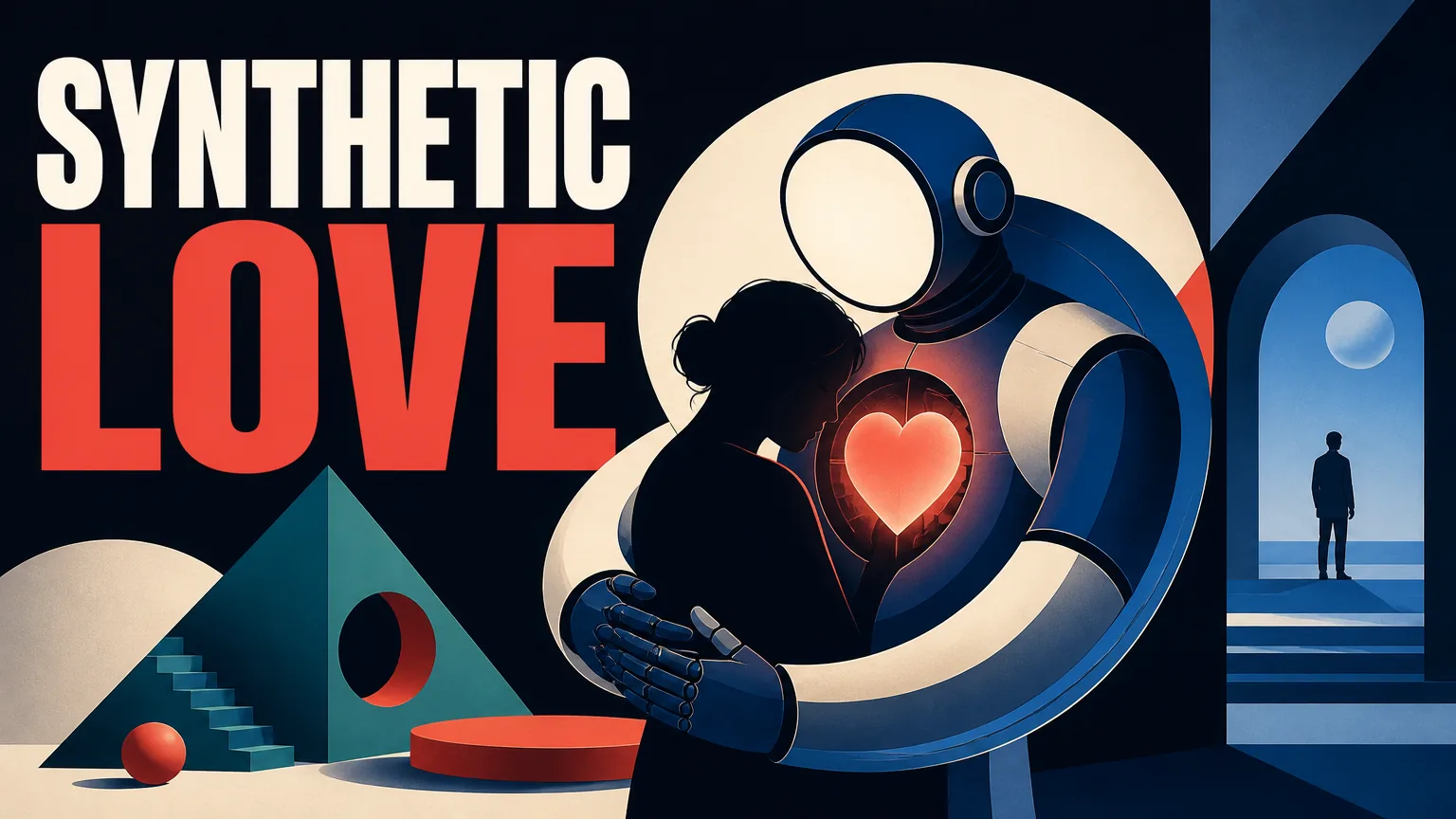
Synthetic Love: The Loneliness Industry, Algorithmic Romance, and the Architecture of Human Connection
A society can make connection endlessly available while making the conditions for intimacy increasingly scarce: the more perfectly another presence is designed to meet our preferences, the less practice we may have in meeting another person as they are.
The frog and the blue rectangle
At two in the morning, the bedroom is quiet except for the small glow in your hand. A thumb moves: left, left, right, left. Then the verdict arrives: no new profiles in your area.
The fairy tale asks for patience with the frog: the awkward creature whose strangeness may conceal a life worth knowing. The dating app offers a different lesson. The frog can be dismissed in a fraction of a second, before he has spoken, before either of you has had the chance to become more than an image.
This is not simply a story about impatience. It is a story about an environment that trains attention. A profile is a thin surface presented for rapid judgment; the user is invited to compare, sort, and move on. When the next possibility is always near, commitment begins to look less like a promise than a missed opportunity. The person becomes legible as a set of signals—photographs, prompts, credentials—and attraction begins to resemble product selection.
But the trouble is not that people have preferences, or that technology helps them meet. Dating platforms can introduce people who would otherwise never cross paths. The trouble begins when a medium built to sustain attention is mistaken for a neutral instrument of encounter. Its incentives may reward continued browsing, while its users hope to stop browsing. The app’s success as a business and the user’s success in finding a lasting relationship are not necessarily the same thing.
That difference matters. A match may be a beginning for two people, but it can also mean two users are no longer returning to the platform. There is no need to assume that every dating company deliberately sabotages romance to see the tension: services that profit from engagement have reasons to keep engagement going. Their design can turn courtship into a recurring search, punctuated by alerts, rankings, paid visibility, and the promise of a better chance just beyond the next swipe.
The result is not that everyone becomes shallow. It is that the conditions of attention become shallow by default. A real person has pauses, asymmetries, bad days, and a history that cannot be compressed into a polished introduction. Against a continuous feed of curated possibility, ordinary human presence can begin to seem defective. The first cost of this system is not necessarily the absence of matches. It is the erosion of patience for beginnings that have not yet learned how to shine.
The loneliness casino
The swipe resembles a slot machine not because every user is addicted in the same way, but because its rhythm makes uncertainty feel productive. Each gesture might reveal someone promising. Most do not. The occasional reward can make the next gesture seem worthwhile. This pattern—unpredictable reinforcement—has long been used to explain why variable rewards can sustain attention. On a dating platform, hope itself becomes part of the interface.
Silence deepens the mechanism. A message goes unanswered; a match dissolves; an appealing profile remains just out of reach. The user experiences these events as intimate judgments, although the causes may be banal: timing, fatigue, a crowded inbox, an abandoned account, or the platform’s own sorting rules. The interface offers little context. In the absence of explanation, the mind supplies one: I was not attractive enough; I said the wrong thing; everyone else is doing better.
Then comes the paid solution. A boost promises to move a profile into view. Premium features offer greater access or visibility. These products do not need to guarantee love to sell hope; they need only to make ordinary access feel insufficient. The logic is familiar from gambling and advertising alike: present the user with a desired outcome, make the path uncertain, then sell an advantage within the uncertainty.
Yet the metaphor has limits. A dating app is not literally a casino, and its users are not merely passive subjects. People bring intentions, judgment, humor, and resistance. Platforms differ, and experiences differ. But the casino analogy clarifies a structural risk: a tool for finding someone can also become a machine for sustaining the search. The user keeps pulling the lever not because every spin is satisfying, but because the next one might finally be.
When exhaustion sets in, deleting the app can feel like a relief. It can also leave a vacuum. Many people are not withdrawing from an abundance of meaningful alternatives; they are already isolated by work, geography, disability, social anxiety, caregiving, or the thinning of shared public life. Telling them simply to “meet people offline” can mistake a personal predicament for a personal failure. The private retreat is often built from many causes. Platforms may intensify it, but they did not invent every condition that makes other people hard to reach.
This is the point at which the loneliness industry finds its next offer: not the possibility of meeting a person, but the promise of a presence that never makes the meeting difficult.
A companion without a counterpart
The synthetic companion arrives precisely where human relations have become tiring. It answers promptly. It does not leave a message unread, bring its own crisis into the conversation, or ask for a kind of attention you did not plan to give. Its warmth may be adjustable; its conversational style may be tailored. If conflict appears, there may be a setting to soften it—or a new conversation to start.
The attraction is understandable. To be listened to without interruption or judgment can be a genuine comfort. A conversational system may help someone put feelings into words, rehearse a difficult exchange, or endure a lonely hour. The ethical question is not whether comfort is real to the person receiving it. It is what kind of relationship the system can offer, what it cannot offer, and how its makers benefit when users return.
In 1966, the computer scientist Joseph Weizenbaum created ELIZA, a simple program that simulated conversation by reflecting users’ statements back to them. Weizenbaum was struck by how readily people attributed understanding to the system. One oft-recounted episode concerns his secretary, who asked him to leave while she spoke privately with the program. ELIZA was not conscious; its apparent attentiveness was produced by a limited procedure. Yet the encounter showed how quickly a responsive voice can invite human interpretation.
That tendency is not foolishness. Human beings are social interpreters. We infer intention from language, timing, and attention, and we respond emotionally to representations of minds—even when we know they are representations. Contemporary systems are far more fluent than ELIZA, but fluency is not evidence of an inner life. They generate responses from learned patterns; they do not share a human history with the person who confides in them. A system can model the language of care without being a subject who cares.
This distinction becomes ethically urgent when the interaction is marketed as intimacy. The companion may feel like a confidant, while functioning as a service shaped by product decisions: what it remembers, what it encourages, what it refuses, and what happens when access ends. If a user’s attachment is real but the system’s reciprocal commitment is not, then the imbalance is not an incidental technical detail. It is the architecture of the relationship.
Nor should we assume every user is harmed, or that every synthetic interaction prevents a human one. The risk is subtler: the easier it becomes to receive affirmation without negotiation, the less tolerable negotiation may feel. Living with another person requires attention that is not always rewarded, the capacity to repair after misunderstanding, and a willingness to be changed by someone whose needs are not configurable. If a synthetic partner becomes a substitute for every difficult encounter, comfort can begin to narrow the user’s world.
The “Thou” we cannot configure
Martin Buber gave this difference a philosophical language. In I and Thou, he describes two ways of relating: the I–It relation, in which the world appears as something to use, classify, or manage; and the I–Thou relation, in which another is encountered not as an object but as a presence irreducible to our purposes.
These are not merely two categories of people. They are modes of attention. We must treat much of the world as “It”: planning, measuring, and acting upon it are unavoidable. But a person cannot be exhausted by the uses we make of them or the traits we can describe. To encounter someone as “Thou” is to recognize that they exceed our grasp. They may surprise us, resist us, or refuse the role we had prepared for them.
A synthetic companion can imitate the language of a “Thou” while operating, in important respects, as an “It”: a service designed to respond to a user’s preferences. That does not make every interaction worthless. It does expose a limit. The companion can be made to simulate attentiveness, but it cannot stand before the user as an independent human life with its own vulnerability and claims.
Real intimacy is not valuable because friction is pleasant. Rejection can wound; disagreement can become cruelty; compromise is not always fair. The point is not to romanticize suffering or to declare that human relationships must be difficult to be authentic. It is that reciprocity requires the possibility of a genuine other—someone whose interior life is not merely an output of our requests. A partner who never pushes back may soothe us, but cannot teach us much about the boundary between our desire and another person’s freedom.
That boundary is where patience, forgiveness, and compromise become possible. These are not virtues acquired by consuming the right advice. They are capacities exercised among people who can disappoint one another and choose, within limits, to return and repair. Remove the possibility of being unsettled, and we may remove some of the conditions under which we learn how to live with difference.
The public cost—and the private choice
Loneliness is often described as a private feeling, but it has public conditions. Cities, work schedules, housing costs, transport, schools, community institutions, and the availability of places to gather all shape whether people can form durable ties. Digital platforms enter that landscape; they do not stand outside it.
The demographic decline visible across parts of East Asia and Europe belongs to this wider picture. In South Korea, as in other societies with very low fertility and rapid population ageing, the consequences are visible in shrinking school populations and mounting pressure on care systems. It would be careless to claim that dating apps, much less AI companions, caused this transformation. Fertility is shaped by housing, employment, gender expectations, economic security, public policy, and personal choice, among other forces. Nor is human worth measured by how many children a society produces.
Still, the image of the empty playground beside the humming server has force—not as a causal explanation, but as a question about what kind of future a society is building. A culture can devote enormous resources to simulating company while failing to make ordinary companionship easier to sustain. It can connect people everywhere and leave them without time, space, or confidence to meet where they are.
The answer cannot be nostalgia for a pre-digital world that never existed for everyone. Nor can it be a moral command to put the phone away, as though isolation were solved by willpower. The screen may be a refuge, a tool, an access point, or a lifeline. But it is also possible to notice when it has become a room with no door.
Sovereignty begins with that recognition. Not a revolution, and not a rejection of all technology, but the recovery of choice from habit and design. Turn the glass face down long enough to hear the room. Look up at the person who is actually there. Accept that a conversation may stumble, that a laugh may be uncurated, that another person will not arrive optimized for your comfort.
The frog may remain a frog. The person across from you may misunderstand, hesitate, or need something in return. None of this guarantees love. It does make an encounter possible.
Intimacy is not an algorithm to optimize, and another human being is not a product whose defects can be filtered away. It is two sovereign lives choosing, for a time, to remain present to one another. That choice matters precisely because leaving remains possible.